.svg)
NCERT released a draft syllabus for Science Class 9 for 2026-27 in its new update. Aligned with the draft syllabus, NCERT Class 9 Science textbook has also been released. The textbook and the syllabus is released as per the reforms in NCF-SE 2023 and NEP 2020. To know more about the updated textbook, follow along with the article.
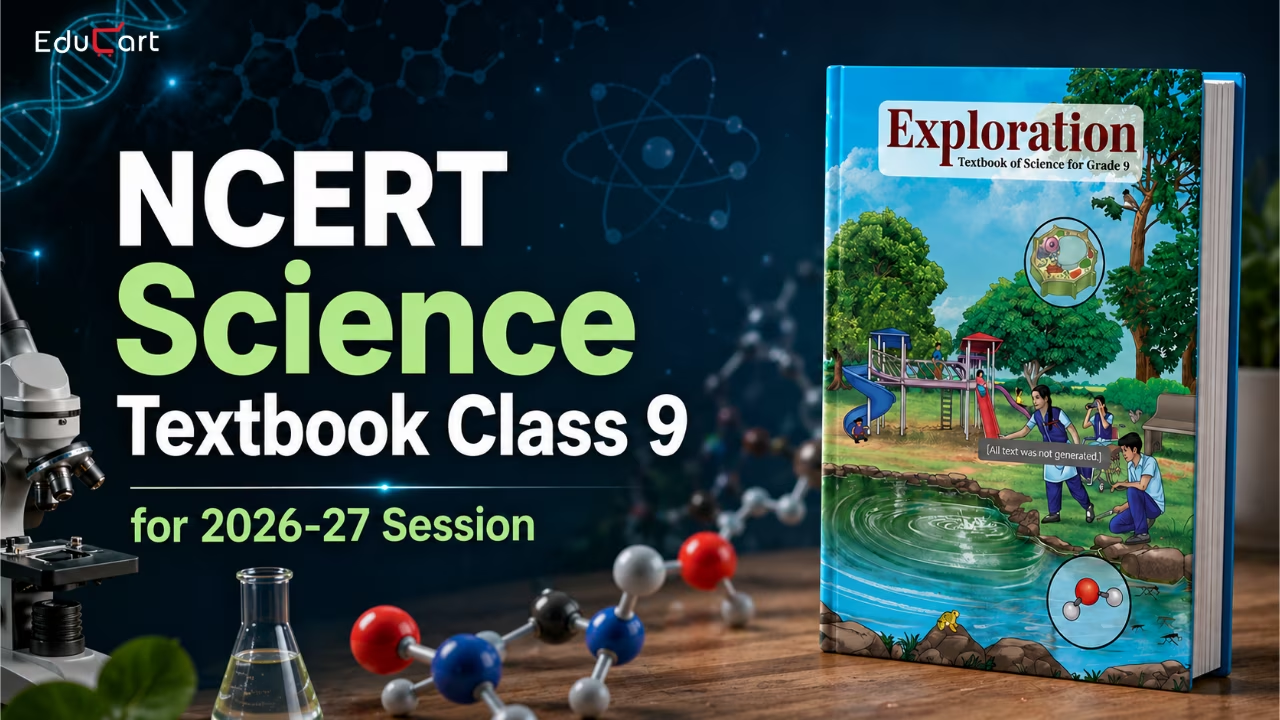
Science NCERT Class 9 PDF 2026-27 - Full Book & Chapter-wise Download
After completing the chapters from the NCERT Class 9 Science Exploration book, test your understanding by solving the exercise questions. Explore the ch-wise NCERT solutions for Class 9 science, fully aligned with CBSE 2026-27 syllabus.
Chapter 1: Exploring: Entering the World of Secondary Science
Chapter 2: Cell: The Building Block of Life
Chapter 3: Tissues in Action
Chapter 4: Describing Motion Around Us
Chapter 5: Exploring Mixtures and their Separation
Each chapter solution provides clear, detailed answers for each Intext, Pause and Ponder, and Activity exercise in a most straightforward manner to make learning accessible.
How to Download Class 9 New NCERT Science Book PDF 2026-27
The Class 9 new NCERT Science book PDF 2026-27, officially titled "Exploration", can be downloaded for free using the links above. You can get the complete science NCERT Class 9 PDF 2026-27 or download individual chapters as needed. This new NCERT Science book for Class 9 PDF 2026-27 replaces the earlier textbook and is the only version valid for CBSE board exams from 2026-27 onwards.
The change is the Science syllabus for Grade 9 took place keeping in mind the following reasons:
- Better alignment with NEP 2020 and NCF-SE 2023: The change shows the 5+3+3+4 structure, focuses on developmental needs for ages 14-18 with competency-based elements like goals, outcomes, time allocation and assessment to deepen students’ understanding and shift from rote learning.
- Learning focused on experience and inquiry: Shift in the way of learning and teaching. Now pedagogy is linked with observation, experimentation, and everyday experiences. The focus is on practical work and real-life applications of what has been taught.
- Reduction in content load for increased conceptual depth: Streamlining topics and focus on important concepts reducing burden of memorisation. Also, it enables deeper reasoning, and analysis with increased participation in environmental issues.
NCERT Book Class 9 Science Exploration (Old v/s New Textbook)
The table shows chapter-wise overview of the changes made in the latest 2026-27 Class 9 NCERT Science textbook compared to the previous year Science textbook.

Strengthen preparation using Class 9 Science previous year questions with solutions.
What Does This Mean for Class 9 Science Teachers?
The changes in the Class 9 NCERT Science textbook are new for both students and teachers. It is important for the teachers to understand the changes properly first. By this it would become easier for them to make the students get along with the changes. Also, teachers have to adapt to interesting methods of teaching to pave their way towards engaging lessons.
The shift is not just in the textbook content but also in the way teachers explain a concept. Now teachers would have to connect Science with other disciplines to cover concepts in a broader manner.
Revise faster using Class 9 Science notes
The structural shift can be seen here:
If you're teaching Class 9 Science from NCERT, there are free cbse specimen books available for teachers that cover chapter-wise practice questions and marking scheme breakdowns - apply and get one delivered to your doorstep.
What Does This Mean for Students?
Students might find it difficult to adjust to the changes in the Class 9 Science NCERT textbook now known as exploration but on understanding how this change will actually help them, adjusting to it would become convenient.
- Deeper conceptual understanding
- Better thinking and problem-solving skills
- Connecting science to real life
- Engaging, low-stress experience
Reinforce your learning with the NCERT Solutions for Class 9 Science, offering detailed answers to every activity in Exploration.
Takeaway
The Grade 9 Science textbook for 2026-27 focuses on promoting experiments, observations and problem-solving skills that are important for the modern world. It focuses on building strong concepts rather than memorizing facts. It encourages students to understand ideas clearly, think logically, and apply science in everyday life.
The new approach connects science with real-life situations, ethics, environment, and innovation. Overall, this is not just a change in topics but a meaningful shift towards making Science practical, engaging, and skill-oriented for students.
FAQs
Q1. Is the new textbook for Class 9 NCERT Science released?
Ans. Yes, the textbooks for Science Class 9 NCERT have been released and are available on the official NCERT website. Students can download the book from ncert.nic.in or from the link provided above in the article.
Q2. How many chapters/themes are there in the new Science syllabus?
Ans. The new syllabus includes 13 integrated themes, covering concepts from Physics, Chemistry, Biology, and Earth Science in a connected manner.
Q3. Has the assessment pattern changed in the new syllabus?
Ans. Yes, the assessment now focuses on competency-based evaluation, including projects, case-based questions, and continuous feedback instead of only final exams.
Q4. How does the new syllabus support skill development?
Ans. The new framework emphasizes:
- Scientific inquiry and experimentation
- Data analysis and modeling
- Logical reasoning
- Communication of scientific ideas
Q5. Why has NCERT merged Physics, Chemistry, and Biology into one integrated approach?
Ans. Because real-world problems are not subject-specific. The integrated approach helps students understand how concepts from different sciences connect in real-life situations.
Q.6 Where can I download the Class 9 new NCERT Science book PDF 2026-27?
Ans. You can download the science NCERT Class 9 PDF 2026-27 (titled "Exploration") for free from the chapter-wise links provided above on this page.













.svg)

